Interactive Voice Response has come a long way from the old, rigid phone menus that forced callers to "press 1 for sales" and "press 2 for support." With conversational AI IVR, your phone system can finally feel as natural and intuitive as talking to a helpful human agent—one that’s fully aligned with modern customer support solutions and the growing need for smarter automation.
Instead of frustrating, linear menus, callers can simply say what they need in their own words and get fast, accurate help. This shift is a powerful example of why contact center AI is essential for scaling customer support. For businesses, that means higher satisfaction, lower costs, and a smarter way to handle every incoming call.
Today’s businesses are under pressure to deliver faster, cleaner service across every channel. That push toward efficiency is one reason many teams explore comprehensive cloud computing resources that help optimize business systems. These cloud-focused insights support modern IVR setups by enabling lighter infrastructure, flexible scaling, and dependable uptime during heavy call periods.
As companies aim to simplify operations even further, many look into high-performance computer technology guidance for smarter automation workflows. These advanced computing principles help strengthen AI voice systems, improving call routing accuracy, reducing customer wait times, and creating smoother interactions for every caller.
Still, technology alone doesn’t guarantee better service. A company’s approach to communication plays a major role in customer satisfaction. That’s why many teams rely on customer-centric marketing practices designed to strengthen long-term engagement. When paired with AI-driven voice systems, these practices help callers feel more understood and better supported throughout the conversation.
To maintain consistent growth, leaders also pull insights from modern digital marketing solutions that elevate customer experience quality. These ideas help brands design AI phone flows that reflect the company’s tone, reduce caller friction, and support a clear, seamless experience at every touchpoint.
Alongside better technology and communication strategies, smart financial planning is essential for scaling service operations sustainably. That’s why companies often explore practical financial management advice for expanding service operations. With the right guidance, businesses can identify where AI automation delivers the strongest return—often by reducing agent workloads, decreasing operational costs, and improving service consistency.
By combining modern computing tools, strong marketing strategy, and thoughtful financial planning, organizations can build support systems that feel simple, human, and responsive—while still relying on AI to deliver speed, accuracy, and reliable service at scale.
Top Contact Center Solutions for Smarter AI Voice Automation
1. Bright Pattern
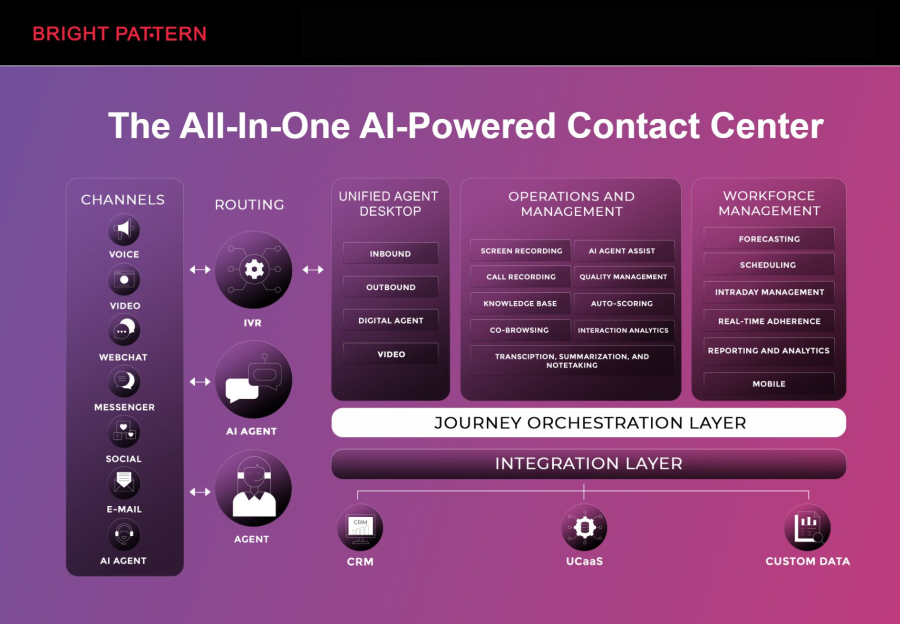
Bright Pattern stands out for companies that want a modern and simple way to upgrade their phone support with intelligent voice tools. Its platform brings together natural call routing, voice automation, and clean workflows that help teams manage more conversations without adding extra workload. It is especially helpful for organizations rolling out ai contact center call center solutions that need quick results without heavy technical setup.
Bright Pattern helps businesses deliver smoother caller experiences through:
- easy omnichannel routing that reduces wait times
- natural language understanding for more flexible call flows
- fast setup with minimal IT support needed
- strong quality tools for tracking performance
- scalable features designed for hybrid or remote teams
Because of its simple, human-like interactions and reliable performance, Bright Pattern is a leading choice for companies upgrading their voice systems with modern automation.

2. Five9
A cloud-based platform known for automation features, routing tools, and service workflows that support large and growing teams.
3. Talkdesk
Offers clean designs, smart call handling, and flexible voice tools well-suited for support operations that want fast improvements.
4. Genesys Cloud CX
A full contact platform with routing, analytics, and automation tools built for organizations with complex service needs.
5. Nice CXone
Provides enterprise-level routing, workforce management, and strong performance insights for high-volume support operations.
6. RingCentral Contact Center
Combines calling, messaging, and digital workflows into one system, making it useful for blended communication needs.
7. Zendesk Talk
A simple voice solution inside the Zendesk ecosystem, ideal for support teams already using Zendesk for tickets.
8. Freshcaller by Freshworks
Easy to set up with clean routing and helpful management tools for small to mid-size service teams.
9. Aircall
Known for quick installation, helpful integrations, and simple voice tools used by distributed support teams.
10. UJET
A modern platform focused on mobile-friendly voice flows, real-time routing, and updated call experiences for digital-first organizations.
What Is Conversational AI IVR?
Conversational AI IVRcombines traditional IVR call routing with advanced technologies like natural language understanding and speech recognition. The result is an automated phone system that can:
- Understand what callers say in everyday language
- Ask clarifying questions and hold multi-turn conversations
- Access back-end systems to provide personalized answers
- Route calls intelligently when human assistance is needed
In practical terms, it turns your phone menu into avirtual agentthat is always on, always consistent, and always ready to help.
Why Traditional IVR Is No Longer Enough
Classic, keypad-driven IVR systems were built for a different era. Today, customers expect effortless, on-demand support, and they are comfortable speaking naturally to digital assistants. When your IVR cannot keep up, you risk:
- Callers abandoning calls due to long or confusing menus
- Unnecessary transfers and repeat explanations
- Overloaded agents handling simple, repetitive requests
Conversational AI IVR addresses these issues by designing experiences around how people actually communicate: with short phrases, questions, and follow-up clarifications.
Key Benefits of Conversational AI IVR
1. Natural, Human-Like Customer Experiences
With conversational AI, callers do not have to remember menu options or listen through long lists. They can simply say things like:
- "I want to check my order status"
- "I need to reschedule my appointment"
- "I want to update my payment method"
The system understands intent and guides the conversation. This leads to:
- Less frictionbecause callers speak naturally
- Shorter call timesas customers reach answers faster
- Higher satisfactionfrom a more intuitive, modern experience
2. 24/7 Availability Without Adding Staff
Human agents need schedules, breaks, and time off. A conversational AI IVR is availablearound the clock, handling routine calls even during evenings, weekends, and holidays.
This always-on support means:
- Customers get help whenever it is most convenient for them
- Peak-time pressure is reduced because overnight and off-peak queries are resolved automatically
- Your brand delivers consistent service, regardless of the time of day
3. Higher Self-Service Containment and Lower Costs
One of the biggest advantages of conversational AI IVR is the ability to handle a high volume of calls automatically. The more calls that can be resolved by the virtual agent, the fewer go to your live team.
This typically leads to:
- Lower cost per contactbecause straightforward tasks are automated
- More efficient staffingbecause agents focus on high-value conversations
- Improved call center productivitydue to reduced handle time and fewer transfers
4. Personalized, Context-Aware Interactions
Modern conversational IVR systems can integrate with CRM, billing, booking, or other back-end systems. When a caller is identified, the IVR can adapt its responses based on:
- Customer profile and segment
- Account status or order history
- Recent interactions across channels
This allows for experiences like:
- "I see you have an open support ticket. Would you like an update?"
- "Your last payment was received on the 10th. Are you calling about something else?"
Context-aware automationmakes conversations feel helpful and relevant, not generic.
5. Seamless Handoffs to Live Agents
Conversational AI IVR is not about replacing human agents. It is about making sure humans focus on where they add the most value.
When a call requires a live agent, the IVR can:
- Transfer the caller to the right skill group
- Pass along conversation transcripts and context
- Reduce the need for callers to repeat themselves
This leads to faster resolutions and a smoother experience for both agents and customers.
Core Capabilities of a Modern Conversational AI IVR
A robust conversational AI IVR typically brings together several technologies and capabilities.
Natural Language Understanding (NLU)
NLUis what allows the system to understand the meaning behind what callers say, not just the exact words. It identifies:
- Intent(what the person wants to do)
- Entities(specific details like dates, amounts, locations)
- Sentiment or urgencyin some implementations
For example, whether a caller says "I want to pay my bill" or "I need to settle my account" , the system can recognize they have the same intent.
Automatic Speech Recognition (ASR)
Speech recognitionconverts the caller's spoken words into text so the AI can process them. High-quality ASR is especially valuable in noisy environments or when callers have different accents and speaking styles.
Dialogue Management
Dialogue managementcontrols how the IVR responds, what questions it asks next, and how it keeps track of context across the conversation.
For example, if the caller says, "I need to change my appointment" and later just says, "Next Thursday" , the system understands that "Next Thursday" refers to the appointment date.
Integrations and Automations
To actually complete tasks for callers, conversational AI IVR typically connects to:
- Customer databases and CRM systems
- Billing and payment platforms
- Booking, scheduling, or order management tools
These integrations turn the IVR from a simple information provider into a powerfulself-service enginethat can update data, process transactions, and trigger workflows.
Analytics and Continuous Improvement
Every interaction with a conversational IVR generates rich data:
- Which intents are most common
- Where callers ask to speak with an agent
- Completion rates for self-service flows
With the right analytics, you can continuously refine prompts, expand automated use cases, and steadily improve bothcontainmentandcustomer satisfactionover time.
High-Impact Use Cases for Conversational AI IVR
Conversational AI IVR can bring measurable value across industries. Here are some high-impact scenarios where it shines.
Banking and Financial Services
- Account balance and recent transaction inquiries
- Card activation, freeze, or replacement requests
- Loan or credit application status updates
- Simple disputes and charge inquiries
By automating routine banking questions, financial institutions can deliver quick, secure, and convenient service while keeping live agents focused on complex financial advice.
Telecommunications and Utilities
- Bill and usage inquiries
- Service outages and restoration status
- Plan changes and add-ons
- Appointment scheduling for installations or repairs
During peak periods, such as widespread outages, conversational AI IVR can handle a surge in calls, provide consistent updates, and dramatically reduce wait times.
Healthcare and Appointment-Based Services
- Appointment booking, changes, and cancellations
- Pre-visit instructions and reminders
- Basic clinic or office information
- Prescription refill requests in some contexts
This kind of automation helps healthcare providers reduce missed appointments, free up front-desk staff, and offer patients a more convenient way to manage their visits.
Retail and E‑Commerce
- Order tracking and delivery status
- Return and exchange information
- Loyalty program and points inquiries
- Store hours and location details
By turning common questions into smooth self-service flows, retailers can improve post-purchase experiences and build stronger customer loyalty.
Sample Customer Journey With Conversational AI IVR
To see how it all comes together, imagine this simple scenario:
- Call initiation: A customer dials your main support number.
- Greeting: The IVR answers, "Hi, you have reached customer support. You can tell me in a few words how I can help you today."
- Intent capture: The customer says, "I want to check my order status."
- Authentication: The IVR asks for a verification detail, such as an order number or phone number.
- Lookup and response: The system retrieves the order, then says, "Your order is on its way and scheduled for delivery tomorrow."
- Next-best action: It adds, "Would you like me to send a confirmation via text message?"
- Closure: The customer confirms, receives the message, and ends the call without ever waiting in a queue.
Everything feels fast, natural, and personalized, delivering a positive impression of your brand.
Designing a Successful Conversational AI IVR
To get the most from conversational AI IVR, it is helpful to think strategically about design and rollout.
Start With High-Value, High-Volume Intents
Begin by identifying the top reasons people call your organization. Typical candidates include:
- Balance or bill inquiries
- Order status or shipment tracking
- Appointment scheduling
- Password resets or simple account updates
Automating just a few of these common interactions can deliver outsized value very quickly.
Design Conversations, Not Menus
With conversational AI, you are no longer limited to rigid menu trees. Focus on:
- Natural language prompts that invite open responses
- Short, clear questions and confirmations
- Graceful ways to ask for clarification when the system is not sure
Think in terms of scripts and flows that mirror how your best human agents speak with customers.
Blend Automation With Human Support
An effective IVR strategy respects customer preferences. Some callers are happy to self-serve; others want a human right away.
Offer options such as:
- "You can tell me what you need, or say 'agent' at any time to speak with a person."
- Automatic handoff when frustration or repeated failures are detected, where supported.
This blended approach ensures your automation enhances customer experience rather than limiting it.
Invest in Testing and Optimization
Like any digital experience, conversational AI IVR improves with iteration. You can:
- Analyze call transcripts to see where callers get stuck
- Refine prompts and responses based on real usage
- Add new intents as you discover more opportunities for self-service
A mindset of continuous optimization allows your IVR to grow more capable and user-friendly over time.
Measuring Success: Key Metrics for Conversational AI IVR
To showcase the value of your conversational IVR, track metrics that connect directly to business outcomes.
Metric | What It Shows | Why It Matters |
Self-service containment | Percentage of calls fully handled by IVR | Indicates automation effectiveness and cost savings potential |
Average handle time | Time to resolve or route calls | Shorter times typically reflect smoother experiences |
Call abandonment rate | How often callers hang up before resolution | Lower rates suggest a more engaging and efficient IVR |
Customer satisfaction (CSAT) | How customers rate their experience | Directly connects automation to perceived service quality |
Agent utilization | How busy agents are with live calls | Shows how automation frees agents for complex tasks |
Future-Proofing Your Contact Center With Conversational AI IVR
As customer expectations continue to evolve, phone remains a critical channel. Many people still instinctively reach for the phone when an issue feels important, urgent, or sensitive.
By deploying conversational AI IVR, you can:
- Modernize your voice channel without forcing customers to change habits
- Offer a consistent experience across phone, chat, and other channels
- Scale customer support sustainably as your business grows
Instead of seeing IVR as a necessary but outdated tool, you can turn it into a strategic asset that delights callers and supports your broader digital transformation.
Bringing It All Together
Conversational AI IVR is changing what is possible over the phone. It blends the accessibility of traditional call centers with the intelligence and convenience of modern AI, giving your organization a powerful way to:
- Deliver fast, natural, and personalized service 24/7
- Reduce operational costs while improving satisfaction
- Empower agents to focus on complex, high-value tasks
- Continuously learn from interactions to refine your customer experience
For organizations that rely on the phone as a key customer touchpoint, conversational AI IVR is not just an upgrade. It is a strategic step toward a smarter, more human-centric customer experience.
When you design your IVR around real conversations instead of rigid menus, every call becomes an opportunity to serve better, respond faster, and leave customers feeling heard and valued.
